Imagine this: one consultant tells you to get more citations. A friend who runs an agency tells you the real answer is backlinks. Both sound confident. Both sound like SEO advice you should trust.
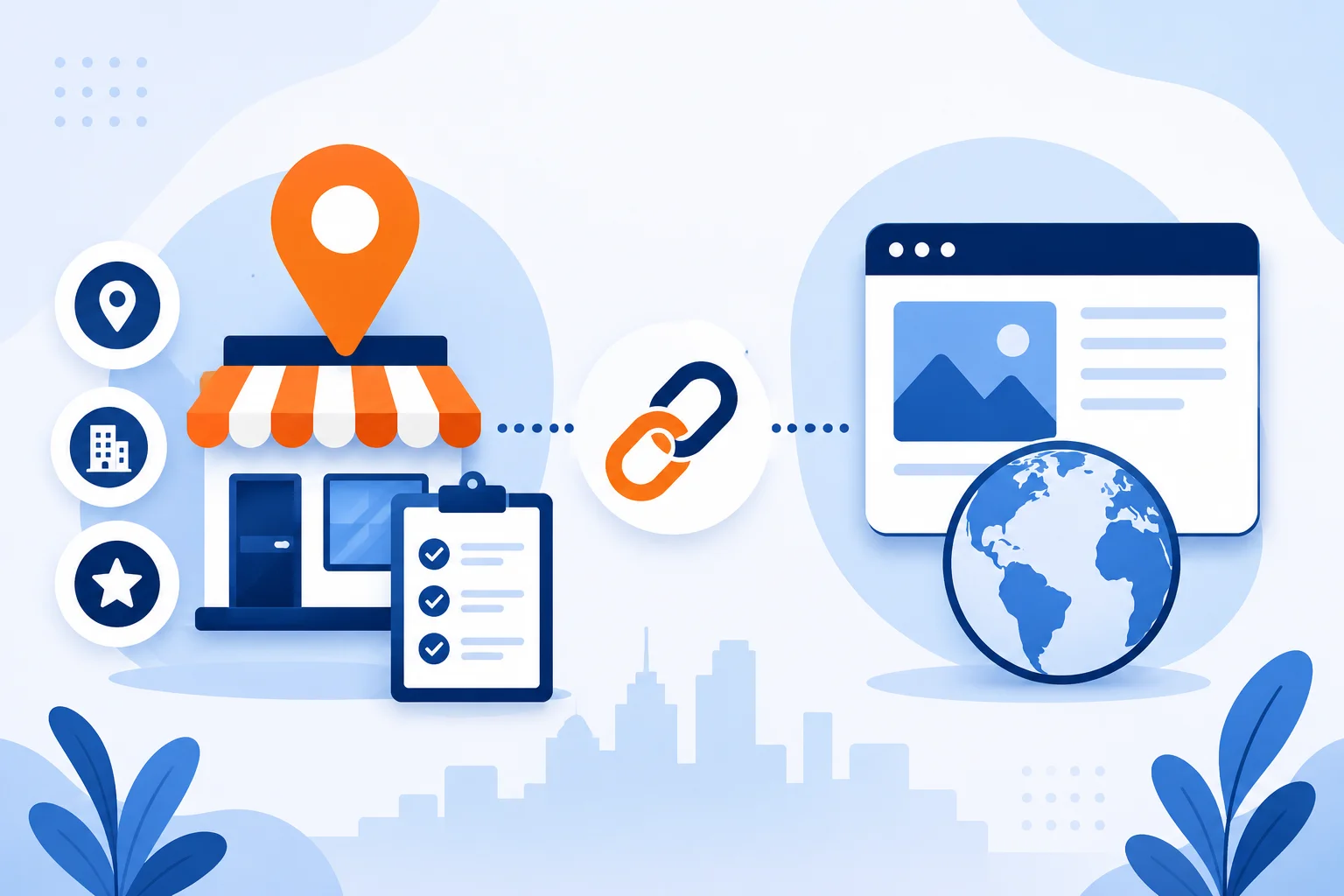
They’re not the same thing, and mixing them up costs local businesses ranking positions they should already have. As a semantic SEO specialist, I see this confusion constantly, especially among small business owners trying to figure out where to spend their time first. This guide breaks down what a local citation and a local backlink actually do, how they work together, and which one deserves your attention first if you’re just getting started with local SEO.
What Is a Local Citation?
A local citation is any online mention of your business’s name, address, and phone number, usually shortened to NAP. It doesn’t need a clickable link back to your site to count. A business directory listing, a chamber of commerce page, or even a mention in a local Facebook group post can all work as citations, as long as the NAP details are accurate.
Citations come in two forms. Structured citations show up in a consistent format, like a directory listing on Yelp or Bing Places where your name, address, and phone number sit in their own fields. Unstructured citations appear inside regular content, like a local news article that mentions your shop’s address in a sentence about the neighborhood.
The strongest citations sit on platforms Google already trusts: Google Business Profile, Yelp, Apple Business Connect, Bing Places, and industry directories relevant to your type of business. Citations don’t have to include a link to matter. Per the formal definition of a citation, a mention of your NAP is enough on its own to help Google confirm your business is real. But when a directory happens to include your website link alongside your NAP, it does double duty for both signals at once, working as a citation and a backlink together.
Is a Google Business Profile a Citation?
Yes, and it’s one of the most important ones you have. Your Google Business Profile is the primary source Google checks to confirm your business exists and where it’s located. Getting your GBP fully filled out and accurate matters more than almost any directory listing you’ll add after it.
What Is a Local Backlink?
A local backlink is a clickable link from a website connected to your area that points back to your site. The key word is clickable. If a blog mentions your restaurant’s name without linking to your website, that’s a citation, not a backlink.
Local backlinks tend to come from sources with some tie to your community: a local news outlet covering your grand opening, a nearby blogger reviewing your services, a chamber of commerce member directory, a sponsorship page for a youth sports team you support, or another local business linking to you as a trusted partner.
Unlike citations, backlinks pass what’s often called link equity. When a site with its own authority links to you, some of that authority transfers over, which helps your site rank for competitive search terms beyond just the map pack. A link from a well-known local newspaper carries far more weight than a mention buried in a low-traffic directory nobody visits.
Local Citation vs. Local Backlink: Key Differences
Once you see them side by side, the differences are easier to keep straight.
| Feature | Local Citation | Local Backlink |
|---|---|---|
| Definition | Mention of your NAP details | Clickable link pointing to your site |
| Requires a link | No | Yes |
| Main purpose | Verifies your business is real and located where it says | Signals trust and authority to search engines |
| Primarily affects | Map Pack visibility | Organic rankings beyond the map pack |
| Where you get them | Directories, GBP, review sites | Local news, blogs, sponsorships, partnerships |
| Difficulty to earn | Relatively easy | Harder, needs outreach or something worth covering |
One industry estimate puts citations and backlinks together at close to half of local ranking authority combined, which is a good reminder that neither one carries the full weight on its own.
Do You Need Both?
Yes, and here’s why relying on just one leaves a gap. Citations tell Google your business exists and where to find it. Backlinks tell Google your business is worth showing above the competition. Skip citations and Google struggles to trust your basic details. Skip backlinks and you might show up in the map pack but stay invisible in the organic results underneath it.
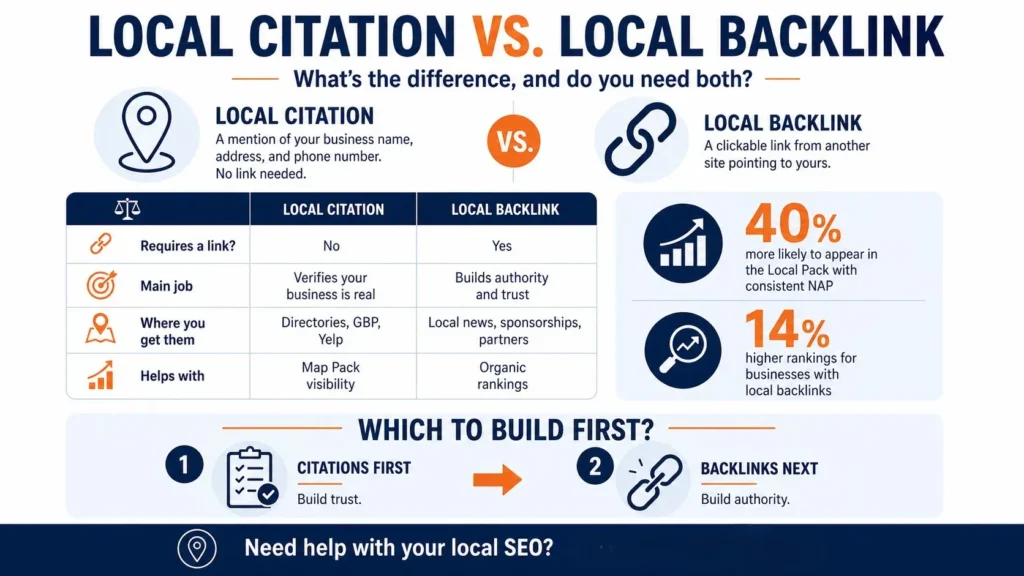
The data backs this up. Businesses with consistent NAP data across major citation sources are 40% more likely to show up in the Local Pack. Meanwhile, businesses with local backlinks rank 14% higher in the Local Pack than those without them, according to recent ranking factor data. Citations still matter, but their direct weight as a ranking factor has been sliding, from 13% back in 2020 down to around 7% now, which makes backlinks a growing part of the equation rather than a nice extra.
Which Should a New Local Business Build First?
Start With Citations to Establish Trust
If your business is brand new or you just moved locations, start with citations. Google needs to confirm you exist before it cares much about your authority. Claim your Google Business Profile, get listed on Bing Places and Apple Business Connect, and make sure your NAP matches exactly everywhere it appears.
Layer In Backlinks Once Your Foundation Is Solid
Once your citations are consistent, sequencing citations before backlinks tends to produce the better payoff, because backlinks pointed at a business Google doesn’t trust yet don’t do much good. After your NAP is locked in everywhere, start reaching out to local publications, joining community organizations, and looking for sponsorship opportunities that come with a link.
If you’re not sure where your business currently stands, my full range of SEO services covers exactly this kind of audit before you start building either one.
How to Build Both
Getting Citations That Actually Help
Claim and fully complete your listings on Google Business Profile, Bing Places, Apple Business Connect, and Yelp first. Add industry-specific directories after that, since niche listings often carry more weight than generic ones for your particular trade. Whatever you do, match your footer NAP to every listing you create, right down to how you abbreviate “Street.”
Earning Backlinks From Local Sources
Reach out to local news outlets when you have something worth covering, like a new location or a community event. Sponsor a local team or nonprofit in exchange for a link on their site. Partner with nearby businesses that serve a similar audience and trade mentions with each other.
None of this happens overnight, but each one builds real authority instead of a shortcut you’ll have to undo later. If building this out yourself feels like more than you have time for, a complete local SEO service can handle the citation cleanup and backlink outreach together instead of leaving you to juggle both alone.
Mistakes That Quietly Hurt Local Rankings
Inconsistent NAP is the biggest one. A different phone number on one directory or a misspelled street name on another confuses Google more than having no listing at all.
Piling up citations on low-quality directories doesn’t help much either. Once your major listings are accurate and complete, adding dozens more rarely moves the needle on its own.
Buying backlinks is another trap worth avoiding entirely. Google’s guidelines flag paid links, and getting caught costs you more than whatever ranking boost you were chasing.
Last one: building backlinks without fixing your citations first. You end up with a site Google finds authoritative but still isn’t fully sure is a real, located business, which caps how high you can climb in the map pack.
At a Glance
Conclusion
Citations and backlinks aren’t competing strategies. They’re two different jobs that both need doing. Citations prove you exist and where you are. Backlinks prove you’re worth ranking above the business down the street. Skipping either one leaves rankings on the table that should be yours.
Start with your NAP consistency, then build outward toward backlinks once that foundation holds. If you’d rather have someone handle the audit and the outreach, check out my complete local SEO service, or let’s talk about what your site needs right now.