
Most people who build a website make the same mistake: they spend months getting the design right, agonize over every color and font, then hit publish and wait. The traffic never comes. Not because the site is bad. Because nobody told Google it exists.
That is the problem SEO solves.
Search Engine Optimization is the practice of making your website visible to people who are already looking for what you offer. Done right, it is the most cost-effective form of marketing available to any business, whether you are running a local coffee shop or a global SaaS product. Done wrong, it is a black hole that swallows time and money with nothing to show.
This guide covers everything from the basics of how search works to the advanced strategies that separate good SEO from great SEO. Whether you are completely new to this or looking to sharpen what you already know, this is your starting point.
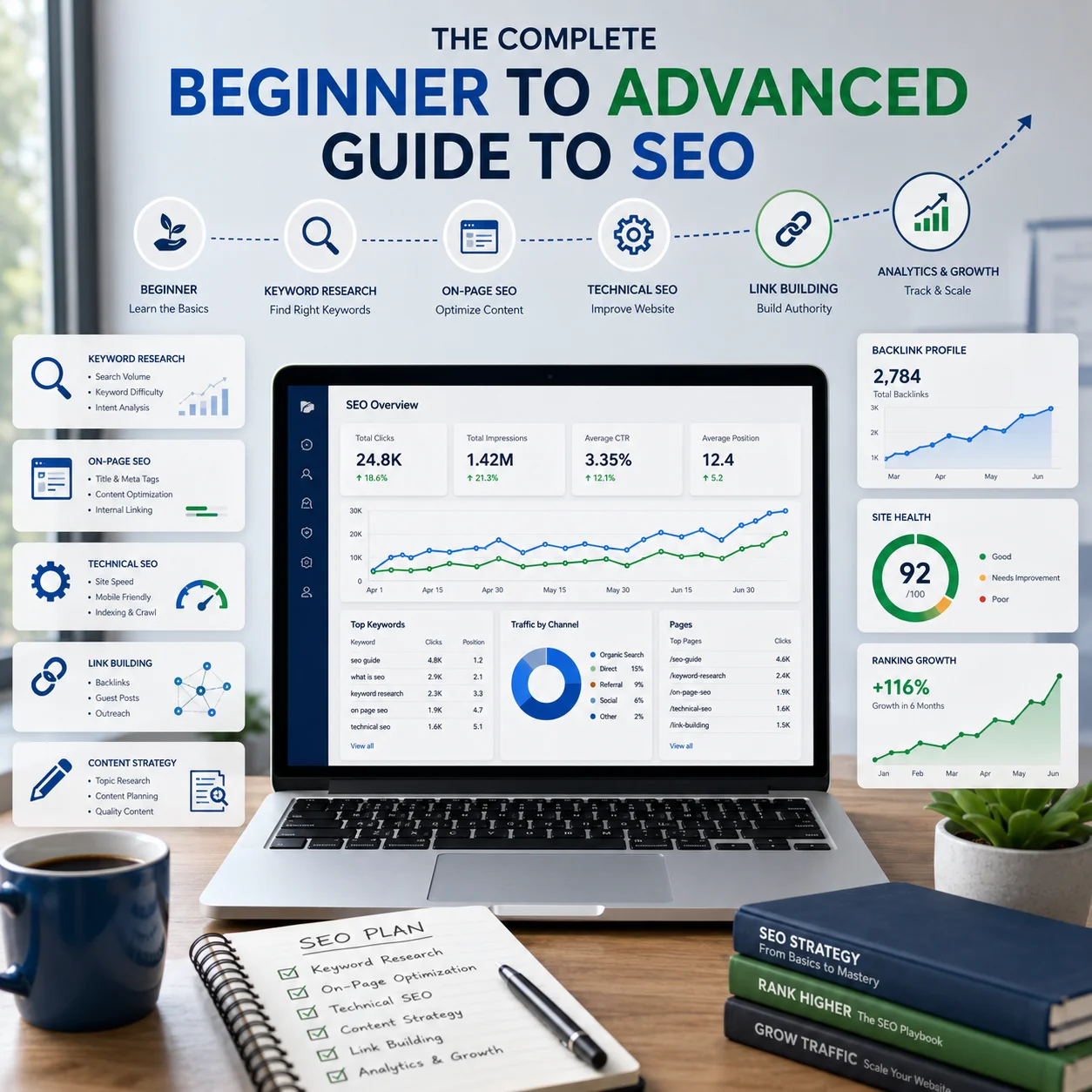
What Is SEO?
SEO stands for Search Engine Optimization. At its core, it is the process of improving your website so that search engines like Google rank it higher in results when people search for topics related to your business.
The key word there is organic. Organic traffic refers to visitors who arrive at your website through unpaid search results. They typed something into Google, your page appeared, and they clicked. No ad spend involved.
Compare that to paid search, where you run Google Ads and pay every time someone clicks. The moment you stop paying, the traffic stops. With SEO, the work you put in compounds over time. A well-optimized page can drive traffic for years after you publish it.
Why does this matter? Because search engines rank pages using complex algorithms that evaluate a wide range of signals to determine relevance, quality, and usefulness for a given search query. The higher your page ranks, the more clicks it gets. And the more clicks, the more customers, leads, or readers.
The business case is simple. If 10,000 people search for your product every month and your page sits at number one, you capture a meaningful chunk of that audience without paying for every visit.
How Search Engines Work
Before you can optimize for search engines, you need to understand what they actually do. The process breaks down into three stages: crawling, indexing, and ranking.
Crawling
Search engines use automated programs called crawlers (or bots) to browse the web. Think of them like very fast, very thorough readers who visit web pages, read the content, and follow every link they find.
When a crawler visits your site, it reads your pages, checks your links, and queues up new URLs to visit later. If a page is not linked from anywhere, the crawler may never find it.
Indexing
Once a page is crawled, the search engine processes and stores it in its index. The index is essentially a massive database of web pages that have been read and categorized. Google uses automated ranking systems that look at many factors and signals about hundreds of billions of web pages and other content in its search index to present the most relevant, useful results, all in a fraction of a second.
If your page is not in the index, it will not appear in search results. Period. This is why technical issues like blocking pages through your robots.txt file or using noindex tags can hurt your visibility.
Ranking
Once indexed, pages are ranked based on hundreds of signals. Search algorithms are largely driven by machine learning, and it is a misnomer to think ranking factors are the same for every industry or query. Google weighs everything from the quality of your content to how fast your page loads to how many credible websites link to you.
Understanding this three-step process helps you think about SEO systematically. You want search engines to find your pages (crawling), store them (indexing), and consider them worthy of top positions (ranking).
Types of SEO
SEO is not a single tactic. It is a collection of strategies that each address a different part of the visibility puzzle.
On-Page SEO
On-page SEO refers to everything you do on the actual page to signal what it is about. This includes the words on the page, how they are structured, the title of the page, images, internal links, and more. It is the most direct form of optimization and usually where beginners start.
Off-Page SEO
Off-page SEO covers signals that exist outside your website. The most important of these is backlinks. When other websites link to yours, search engines treat those links as votes of confidence. Backlinks act like votes of confidence. The more high-quality backlinks you have, the higher your website will rank.
Off-page SEO also includes your brand reputation, reviews, social mentions, and how your business appears across the web.
Technical SEO
Technical SEO is about making sure search engines can access and understand your website without friction. This covers site speed, mobile-friendliness, crawlability, structured data, and fixing errors that prevent proper indexing. Technical SEO ensures that your website is optimized for search engines. Factors like site speed, mobile-friendliness, and crawlability play a crucial role in how Google indexes and ranks your site.
Local SEO
Local SEO is for businesses that serve a specific geographic area. It focuses on appearing in local search results and on Google Maps when someone searches for services near them. Optimizing your Google Business Profile, building local citations, and collecting reviews are the core activities here. If you run a physical business or serve a local market, local SEO is essential and deserves its own dedicated strategy.
Keyword Research
Every piece of SEO content starts with keyword research. Before you write a single word, you need to know what people are actually searching for.
What Are Keywords?
Keywords are the words and phrases people type into search engines. “Best running shoes for flat feet” is a keyword. So is “SEO guide.” Your job is to find the keywords your target audience uses and create content that answers their queries better than anyone else.
Long-Tail Keywords
Long-tail keywords are longer, more specific phrases. Instead of targeting “shoes,” you might target “best waterproof trail running shoes for wide feet.” Long-tail keywords articulate more specific search intent and are often used by people who are further down the conversion funnel.
Long-tail keywords have lower search volume but are often much easier to rank for. For a new website with little authority, going after long-tail keywords is a smart entry strategy. You can realistically land on the first page and start building traffic while you work toward more competitive terms.
Search Intent
Every search has an intent behind it. There are four main types:
| Intent Type | What the User Wants | Example Query |
|---|---|---|
| Informational | To learn something | “how does SEO work” |
| Navigational | To find a specific site | “Google Search Console login” |
| Commercial | To research before buying | “best SEO tools 2025” |
| Transactional | To complete an action | “buy Ahrefs subscription” |
Matching your content to the right intent is critical. If someone searches “how does SEO work,” they want an explanation, not a product page. Publishing the wrong type of content for a query will hurt your rankings, no matter how well-written it is.
Keyword Difficulty
Keyword difficulty is a measure of how hard it is to rank for a given term. High-difficulty keywords are dominated by large, authoritative sites. Semrush’s Keyword Magic Tool displays metrics including search volume, intent, keyword difficulty, and CPC to help you build an organized, data-driven keyword strategy.
When starting out, target keywords with lower difficulty scores where your content can realistically compete.
Free Keyword Tools
You do not need an expensive subscription to do solid keyword research when you are starting out. Several free tools can help:
- Google Keyword Planner: Built into Google Ads, it shows search volume and competition levels.
- Google Search Console: Shows you what keywords your site already ranks for, along with impressions and clicks.
- Keyword Tool (keywordtool.io): The free version can generate up to 750+ keywords from Google autocomplete in seconds.
- AnswerThePublic: Shows the questions people ask around a topic, useful for content ideas.
As your site grows and your needs become more specific, investing in tools like Semrush or Ahrefs gives you deeper competitive data and more accurate metrics.
On-Page SEO
On-page SEO is where you take your keyword research and apply it directly to your content and page structure.
Title Tags
The title tag is the HTML element that defines the title of a web page. It appears in search results as the clickable blue link. Search engines use title tags to influence their decision on whether your content should show for a given query.
Best practices for title tags:
- Keep them under 60 characters to avoid being cut off in search results.
- Put your primary keyword near the front.
- Make them accurate and descriptive. Clickbait titles that do not match the content hurt your click-through rate and your rankings.
Meta Descriptions
The meta description is the short paragraph under the title in search results. It is not a direct ranking factor, but a well-written meta description increases click-through rate, which does influence your rankings. Aim for around 150–160 characters and include a clear reason for the searcher to click.
Heading Tags
Headings (H1, H2, H3) help structure your content for both readers and search engines. Incorporating relevant terms in headings and structuring them logically helps search engines understand whether your content is relevant to a given query.
Use one H1 tag per page, which should contain or closely relate to your primary keyword. H2s and H3s organize the rest of your content into logical sections.
Image SEO
Images make content more engaging, but search engines cannot see them the way humans do. Alt text is the HTML attribute that describes an image. Writing descriptive alt text can also help you appear in image search results. Keep alt text concise and descriptive. If it naturally includes a keyword, great. Do not force it.
Also compress your images before uploading. Large image files are one of the most common reasons pages load slowly, which hurts both user experience and rankings.
Internal Linking
Internal links are links between pages on your own website. They serve two purposes: they help users navigate your content, and they pass authority from one page to another. A well-linked site helps search engines understand the structure of your content and which pages are most important.
When you write new content, look for opportunities to link to other relevant pages on your site. And when you publish something new, link to it from existing pages.
Content Optimization
Good content is the engine of SEO. You can get the technical details right, build backlinks, and nail your title tags, but if the content itself does not satisfy what someone was looking for, none of the other work matters.
Content Freshness
Content recency has become a more significant factor in Google’s algorithm. Even articles targeting transactional keywords rank higher when they have a newer date of publication.
This does not mean you need to publish constantly. It means keeping your important pages updated. Revisit high-traffic posts every six to twelve months to refresh statistics, update outdated information, and add new insights.
Topical Authority
Topical authority is the idea that covering a subject comprehensively signals expertise to search engines. Instead of writing one post on a broad topic, you build a cluster of content: a main pillar page on the core subject and supporting pages covering related subtopics. Demonstrating expertise on a specific topic, known as topical authority, is becoming increasingly important. Topical authority means becoming your niche’s go-to source for information by creating content that comprehensively covers your subject matter.
Internal links between the pillar and the supporting content strengthen the cluster further.
NLP and Semantic Keywords
Modern search engines do not just match keywords. They understand meaning. Google uses natural language processing (NLP) to understand context and relationships between concepts. This means you should write naturally and include related terms and synonyms, not just repeat your primary keyword.
If your page is about coffee brewing, naturally mentioning terms like “extraction,” “grind size,” “pour over,” and “water temperature” helps Google understand that your content genuinely covers the topic.
E-E-A-T
Google measures content quality through its E-E-A-T guidelines (Experience, Expertise, Authoritativeness, and Trustworthiness). Websites that demonstrate strong expertise in their field and have authoritative sources tend to rank higher.
To signal E-E-A-T:
- Show real credentials, author bios, and first-hand experience in your content.
- Cite credible sources.
- Keep your content accurate and up to date.
- Build a trustworthy site with a clear privacy policy, HTTPS, and transparent contact information.
E-E-A-T is especially important in categories Google calls YMYL (Your Money or Your Life) — health, finance, legal topics — where the stakes of bad information are high.
Technical SEO Basics
Technical SEO sets the foundation for everything else. Your content can be excellent, but if search engines cannot access or understand your site properly, your rankings will suffer.
XML Sitemap
An XML sitemap is a file that lists all the important pages on your site. It acts as a roadmap for search engine crawlers. An XML sitemap is a file that helps guide search engine algorithms through your website’s structure, making it easier for them to crawl, index, and rank critical webpages.
Most WordPress plugins like Yoast or Rank Math generate your sitemap automatically. Submit it through Google Search Console to make sure Google is aware of your pages.
Robots.txt
The robots.txt file tells search engine crawlers which parts of your site they are and are not allowed to access. It is a simple text file, but an incorrectly configured one can accidentally block your entire site from being indexed. Always check that your robots.txt is not inadvertently preventing crawlers from reaching important pages.
Core Web Vitals
Core Web Vitals are Google’s set of metrics for measuring the real-world user experience of a page. They measure:
- Largest Contentful Paint (LCP): How quickly the main content loads.
- Interaction to Next Paint (INP): How quickly the page responds to user input.
- Cumulative Layout Shift (CLS): How stable the layout is as the page loads (elements jumping around is bad).
Core Web Vitals are Google’s measurements of your website’s loading speed, stability, and responsiveness. You can check your scores using Google’s PageSpeed Insights or within Google Search Console.
Mobile SEO
If you want to reach visitors in 2025, your site needs to be easy to navigate on mobile phones and tablets. Google has shifted to a mobile-first world, meaning it expects mobile visitors to be the primary target of your web design.
Google primarily uses the mobile version of your site for indexing and ranking. If your mobile experience is poor, your rankings will reflect that even for users searching on desktop.
For WordPress sites, regular maintenance keeps your site fast, secure, and technically sound. A WordPress maintenance service can handle updates, performance tuning, and technical checks so you can focus on content.
Link Building
Backlinks remain one of the most powerful ranking signals in SEO. A backlink from an authoritative, relevant site is essentially a vote of confidence. The more of these you earn, the more Google trusts your content.
The key word is earn. Mass-purchasing links or using link farms will get your site penalized. The goal is building genuine relationships and creating content worth linking to.
Guest Posting
Guest posting means writing content for other websites in your industry. In return, you typically get a link back to your site. This works best when you contribute to sites with real audiences and genuine relevance to your niche.
The process: identify respected publications in your space, pitch a specific article idea that adds value to their readers, write a thorough piece, and include a natural link to your site.
HARO (Help a Reporter Out)
HARO is a platform where journalists post requests for expert sources, and you respond with relevant insights. If a journalist uses your quote, you earn a mention and often a backlink from a high-authority publication. You can include original quotes from expert sources using a platform like HARO (Help a Reporter Out).
It takes time to monitor requests and write responses, but a single link from a major publication can meaningfully move the needle on your domain authority.
Broken Link Building
This technique involves finding links on other websites that point to pages that no longer exist (404 errors). You then contact the website owner, let them know their link is broken, and suggest your relevant content as a replacement. It is a practical win-win.
Tools like Ahrefs or Semrush make it easy to find broken link opportunities at scale.
What Makes a Good Backlink?
Not all backlinks are equal. The table below breaks down what makes a link valuable:
| Factor | What to Look For |
|---|---|
| Domain Authority | High authority domains pass more ranking power |
| Relevance | Links from sites in your industry carry more weight |
| Link Placement | In-content links are more valuable than footer or sidebar links |
| Anchor Text | Descriptive, natural anchor text is best; over-optimized text can look spammy |
| Dofollow vs. Nofollow | Dofollow links pass authority; nofollow links still provide referral traffic |
SEO Tools
The right tools make every part of SEO faster and more precise. Here are the ones worth knowing.
Google Search Console
Free and essential. Google Search Console shows you how your site performs in Google search. You can see which queries drive traffic, which pages have indexing issues, your Core Web Vitals scores, and which sites link to you. Every website should have it set up from day one.
Google Analytics
Also free. Google Analytics tracks what happens after someone arrives on your site — which pages they visit, how long they stay, where they drop off, and what actions they take. Connecting it with Search Console gives you a full picture from search query to conversion.
Ahrefs
Ahrefs is widely considered one of the best all-around SEO tools. Its backlink database is massive, its keyword research tools are thorough, and the site audit feature catches technical issues efficiently. It is a paid tool, but the data quality justifies the cost for anyone serious about SEO.
Semrush
Semrush is a strong competitor to Ahrefs with a slightly different feature set. It tends to be stronger on competitor analysis and PPC data, while also offering solid keyword research and site auditing. Semrush’s Keyword Magic Tool generates extensive lists of related keywords, groups them by topic, and helps you build an organized, data-driven keyword strategy.
Both Ahrefs and Semrush offer free trials or limited free versions, so you can test before committing.
Common SEO Mistakes
Even experienced SEOs make these errors. Knowing what to avoid saves you from losing rankings you worked hard to build.
Keyword Stuffing
Keyword stuffing is the practice of overloading content with keywords in an unnatural way. It was a functional strategy in the early days of search. Today it is a direct ranking penalty. Write for humans first. Include your keyword where it reads naturally and let the content flow.
Thin Content
Thin content is content that adds little or no value. Short pages that barely cover a topic, auto-generated text, and shallow articles that restate the obvious without providing genuine insight all fall into this category. Search engines like Google prioritize well-researched, comprehensive, and unique content that provides genuine value to users.
If a page does not genuinely help the person who reads it, it will not rank well.
Duplicate Content
Duplicate content means the same or very similar content appearing on multiple URLs. This can happen through printer-friendly page versions, HTTP versus HTTPS versions of URLs, or similar pages targeting slightly different keywords. Search engines are unsure which version to rank and may suppress both. Use canonical tags to tell search engines which version is the original.
Orphan Pages
Orphan pages are pages with no internal links pointing to them. Search engine crawlers find pages by following links. If no page on your site links to a given page, crawlers may never find it and it may never rank. Issues like broken links and pages that are not linked from any other pages on your website can affect rankings and hinder search engines’ ability to effectively crawl, index, and rank your website.
Do a periodic audit of your site to make sure every page is reachable through internal links.
SEO Trends to Watch
SEO is not static. The way search works has changed significantly in the past few years, and the pace of change is accelerating. Here is what matters most right now.
AI and Search
The biggest shift in search right now is AI Overviews. Google now generates AI-written summaries that appear at the top of many search results, answering the query directly before the user sees any organic links. Google’s AI Overviews and LLMs are stealing clicks by answering users’ questions. Users no longer have to scroll search results to get answers or product suggestions.
This is shaping SEO in a real way. For informational queries especially, fewer users click through to the underlying pages. The response from SEOs has been twofold: focus on creating content that gets cited within AI Overviews, and pursue queries where AI cannot fully replace the experience of visiting your site (product pages, tools, original research).
In 2025 and beyond, the ability to acquire new customers organically will not be measured only in new clicks to your site, but also in whether your brand is cited in AI engines.
Voice Search
In 2025, nearly 30% of all web searches come from voice or image queries. Voice search queries tend to be longer and more conversational than typed searches. “What are the best SEO tools for beginners?” rather than “best SEO tools.”
To optimize for voice search, write content in a natural, conversational tone. Include FAQ sections that directly answer common questions. Structure your answers clearly so that a voice assistant can read them out cleanly.
Topical Authority Is Not Optional Anymore
SEO in 2025 became more about meaning and authority than keyword placement. Long-form, expert content outperformed generic 500–700 word posts.
A single well-optimized page used to be enough to rank for competitive terms. Today, Google favors sites that demonstrate comprehensive knowledge of a subject. Building topic clusters, publishing consistently within your niche, and linking your content together into a coherent structure is the path to sustained rankings.
Putting It All Together
SEO is not a one-time setup. It is an ongoing practice that compounds over time. The sites that consistently win in search are the ones that do the fundamentals well, keep improving, and stay patient.
Here is a practical starting framework:
- Do keyword research before creating any content. Know what people are searching for and match your content to their intent.
- Optimize every page you publish with a clear title tag, meta description, proper headings, and natural keyword usage.
- Build your technical foundation: submit a sitemap, check your Core Web Vitals, and make sure your site is fast and mobile-friendly.
- Create content that genuinely serves the reader. Thin, shallow content does not rank anymore.
- Build backlinks through guest posting, HARO, and creating content worth linking to.
- Track your performance in Google Search Console and Google Analytics. Double down on what works.
- Keep your content fresh. Update important pages regularly and remove or improve thin content.
If you are building an online store and want SEO that drives real product sales, a targeted ecommerce SEO strategy is different from a standard content play — product pages, category pages, and schema markup become the priority.
The fundamentals covered in this guide apply no matter the type of website you run. What changes is the emphasis and the execution. Start with the basics, get consistent, and build from there.
SEO rewards the people who approach it seriously. Not obsessively, not frantically chasing every algorithm update, but with consistency and a genuine commitment to creating something useful. The search engines are trying to answer people’s questions with the best content available. Your job is to make sure that content is yours.
If you found this guide helpful and want to go deeper on any particular area — keyword research, local SEO, technical audits, or link building — the resources linked throughout this post are good starting points. And if you would rather hand the strategy and execution to someone who does this every day, mdnazmulalam.net covers SEO and digital marketing services built around results, not just rankings.
Related Content:
- The Difference Between Crawl Budget and Index Budget (And Why You Should Actually Care)
- Why Every Ecommerce Store Needs SEO for Being Successful
- How Google Actually Ranks Your Website (And What You Can Do)
- SEO is Not a One-Time Task; The Answer is Not Clear-Cut
- Is Investing in SEO Worth It? A Complete Guide to SEO Costs
- The Power of SEO in the Google Era
- The Power of Quality Content
- Why Google Takes Time to Rank a New Website?
- 8 Google’s Free Tools Can Help Improving Ranking