You sell products online. Your store ships nationwide — maybe even internationally. You don’t have a storefront, a showroom, or a reception desk. So when someone tells you to “set up your Google Business Profile,” your first thought is probably: does that even apply to me?
It’s a fair question. Google Business Profile (GBP) is the tool that puts businesses on Google Maps and in local search results. And if you’re 100% online, the whole “local” angle seems a bit irrelevant.
Here’s the thing: the answer isn’t a flat no. There are real benefits an online-only ecommerce business can get from GBP — but there are also genuine limits you need to understand before you start. This post walks through what Google’s rules actually say, what you stand to gain, and where the tool won’t help you the way it helps brick-and-mortar stores.
First, Can an Online-Only Business Even Create a Google Business Profile?
Let’s answer the eligibility question before anything else. Because there’s a lot of conflicting advice out there, and some of it will get your profile suspended.
What Google’s Eligibility Rules Actually Say
Google’s official GBP guidelines are clear on one core requirement: your business must have direct, in-person interaction with customers. That can mean customers come to you, or you go to them. Either way, there has to be real human contact.
For ecommerce, this creates a grey area. A purely online store that ships products and never interacts with customers face-to-face technically falls outside Google’s standard eligibility rules. But many online businesses do qualify — particularly if they also offer local pickup, local delivery, or any kind of in-person service alongside their online sales.
If that’s your situation, you can register as a Service Area Business (SAB). This lets you define the geographic region you serve instead of listing a storefront address. You can hide your home or warehouse address and still appear in Google Search and Maps.
The businesses that definitely don’t qualify: passive websites, informational blogs, and online-only stores with zero in-person customer interaction.
What If I Don’t Have a Physical Address? (FAQ)
You don’t need to display one. If you’re setting up as a Service Area Business, Google lets you hide your address entirely. What you do need is a real location you operate from — not a P.O. box, not a virtual office. Google won’t verify a mailbox.
During setup, you’ll enter your actual address for verification purposes, then choose to hide it from your public profile. You then set your service area by city, region, or postcode. This is how home-based sellers, local delivery businesses, and online stores with any kind of in-person touchpoint can show up on Google without exposing a home address.
The Real Benefits of GBP for an Ecommerce Brand
Assuming you’re eligible — or close enough that you qualify through a local delivery or pickup option — here’s where GBP actually earns its keep.
Reviews and Trust — The Thing Most Online Stores Underestimate
This is the biggest one. Online shoppers are skeptical by nature, especially when they haven’t heard of your brand before. They look for proof that you’re real, that you deliver, and that your products are what you say they are.
Google holds 73% of all online reviews, which means it’s the first place most people look. And according to recent consumer data, 67% of shoppers trust Google reviews more than any other platform, with 93% reading reviews before making a purchase.
A Google Business Profile gives your brand a place to collect those reviews. Every positive review is visible directly in Google Search results when someone looks up your business name. That social proof builds trust before a potential customer even clicks through to your website.
Without GBP, those reviews don’t exist in any centralized, Google-visible way. You might have great feedback on your site, but verified GBP listings earn roughly twice the consumer trust of unverified ones. That’s a meaningful gap.
Branded Search and the Knowledge Panel Effect
Here’s a benefit that has nothing to do with local SEO, and it matters a lot for ecommerce brands.
When someone Googles your brand name, a well-set-up GBP triggers a Knowledge Panel on the right side of the search results. This panel shows your business name, logo, website link, contact details, star rating, and reviews — all in one place, without the user having to click anywhere.
This is prime SERP real estate you’re not paying for. It signals to anyone searching your brand that you’re a legitimate, established business. It pushes down any unflattering third-party listings or competitor results that might otherwise appear in that space. And it gives first-time visitors an immediate summary of who you are and what you sell.
For an ecommerce brand trying to build recognition, this kind of branded search presence is genuinely useful. It’s the difference between looking like an established store and looking like a website someone set up last weekend.
Does a GBP Help With Organic Rankings If I’m Not a Local Business? (FAQ)
Indirectly, yes — but not in the way most people think.
GBP doesn’t directly boost your rankings for generic product keywords like “running shoes” or “organic skincare.” Those rankings come from your website’s on-page SEO, backlinks, site structure, and content. If you want to get serious about that, a proper ecommerce SEO strategy is what moves the needle.
What GBP does is strengthen your brand entity in Google’s eyes. When your business name, website, and contact details are consistent across your GBP and your website, Google gets a clearer, more confident picture of what your business is. That consistency contributes to your E-E-A-T signals — Google’s measure of experience, expertise, authoritativeness, and trustworthiness. And E-E-A-T plays a real role in how Google ranks your pages.
It’s not a direct ranking lever, but it’s not noise either.
Where GBP Has Real Limits for Online Stores
None of this means GBP is a silver bullet for ecommerce. There are things it simply won’t do for you if you’re online-only.
Can I Rank in the Local Pack Without a Physical Address? (FAQ)
The Local Pack — those three business listings that appear at the top of Google results for searches like “running shoes near me” — is almost entirely driven by proximity to the searcher and the presence of a verified physical address.
If you don’t have a physical storefront or a genuine service area that covers the searcher’s location, you won’t rank in the Local Pack. That’s just how the algorithm works. Service Area Businesses can sometimes appear for local searches within their defined region, but competing with businesses that have real physical locations in that area is difficult.
For pure e-commerce brands, the Local Pack isn’t the goal anyway. Your traffic comes from product searches, category pages, and brand searches — not “near me” queries. That’s a different SEO game entirely, and one that’s played on your website, not your GBP. A solid local SEO service makes sense for businesses with a genuine local footprint, but if you’re online-only, your energy is better spent on your site’s organic performance.
How to Set Up a Google Business Profile as an Online-Only Business
If you’ve decided GBP is worth pursuing, here’s how to approach it correctly.
Choose the right business type. When Google asks whether customers visit your location or you serve customers at their location, select the service area option. Don’t enter a P.O. box or virtual office — these won’t pass verification.
Pick the right category. “Online retailer” is a legitimate category. Choose the one that best describes what you sell. Getting this right affects which searches you’re eligible to appear in.
Complete every field. Business description, website URL, phone number, hours, and product/service listings all matter. A thin profile gets less visibility than a complete one.
Get verified. Google will ask you to verify your business, usually via video, phone, or email. For home-based or online businesses, video verification is now the most common method. You’ll typically show your workspace, any branded packaging, and your products.
Actively collect reviews. Once your profile is live, ask customers to leave Google reviews after purchase. You can send review request links directly via email. Don’t offer incentives — Google flags this and it can get your profile penalized. Respond to every review, including the negative ones. It signals to both Google and future customers that you’re engaged and accountable.
Post regularly. GBP posts expire after seven days. Posting product updates, offers, or news keeps your profile active and shows Google your business is current.
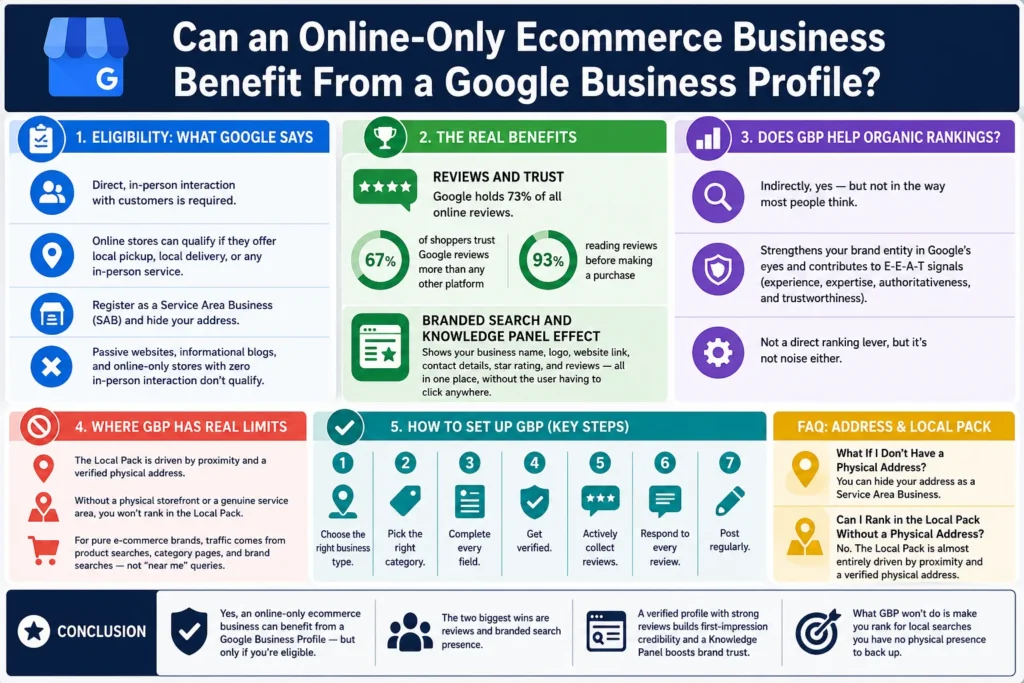
At a Glance
Conclusion
The honest answer is: yes, an online-only ecommerce business can benefit from a Google Business Profile — but only if you’re eligible, and mostly for trust and brand visibility reasons rather than local search rankings.
The two biggest wins are reviews and branded search presence. A verified profile with a strong review count builds the kind of first-impression credibility that converts cautious first-time visitors. And a Knowledge Panel in branded search results tells Google — and your potential customers — that you’re a real, established business.
What GBP won’t do is make you rank for local searches you have no physical presence to back up. For that kind of organic visibility, the work happens on your website.
If you want help getting your ecommerce store found online — whether that’s on-page SEO, schema markup, or site structure — check out my SEO services.