
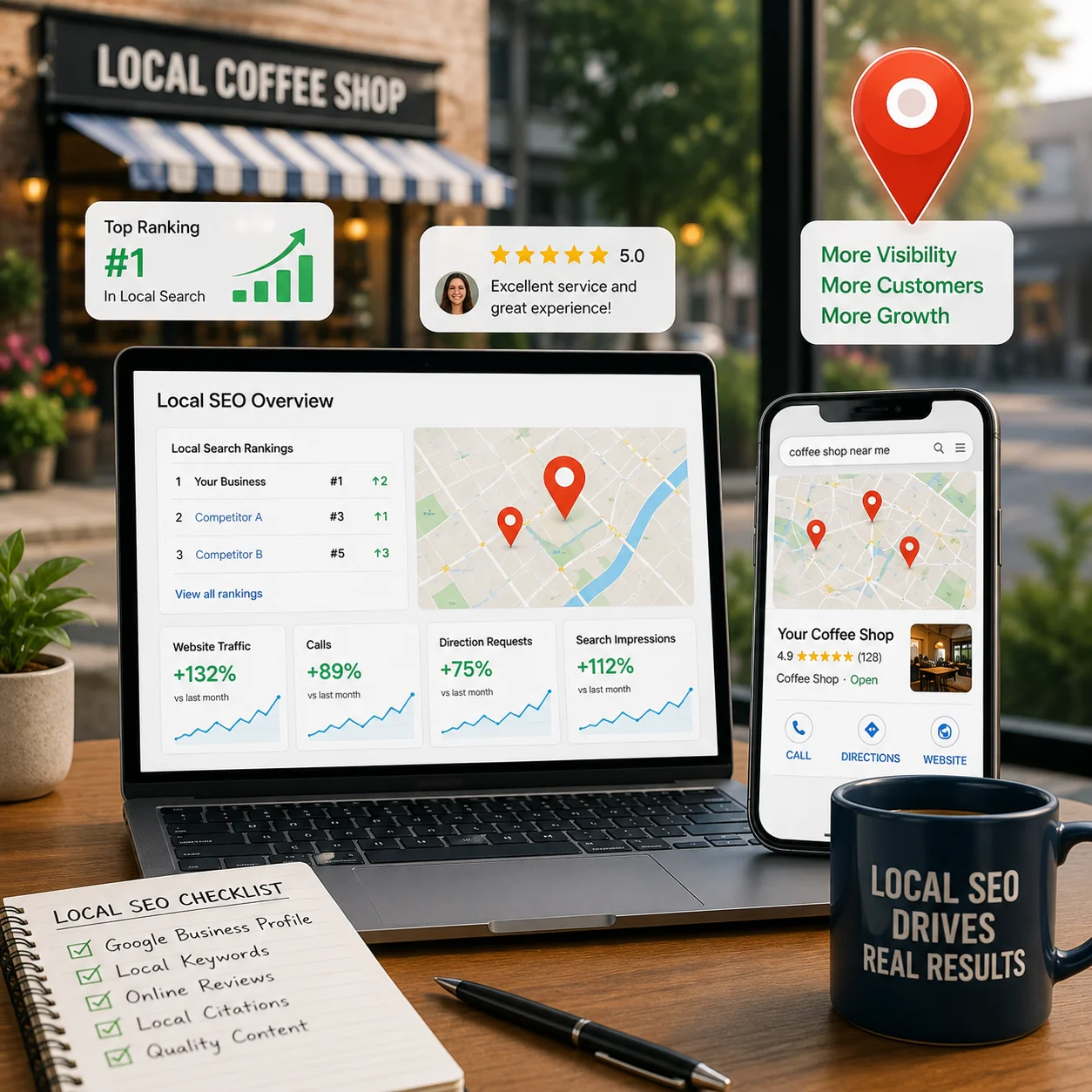
You built a great business. You have the skills, the service, and the reviews to back it up. But when someone two miles away searches for exactly what you offer, your competitor shows up and you don’t.
That’s a local SEO problem, and it’s more fixable than you think.
This local SEO guide walks through everything a small business owner needs to understand — from how Google Maps rankings actually work to the exact steps that move the needle. No fluff, no vague advice. Just what works.
What Is Local SEO?
Regular SEO is about ranking in search results for keywords, regardless of where the searcher is. Local SEO is about ranking for searches with location intent — someone looking for a business, service, or product near them.
The biggest difference shows up in the results. When you search “coffee shop” while sitting in Austin, Google doesn’t show you results from Seattle. It shows you a map with three highlighted listings at the top. That’s the Local 3-Pack (or Map Pack), and it’s the most valuable real estate in local search.
How Google Maps Rankings Work
According to Google, local results come down to three factors:
- Relevance — How well your business profile matches what someone searched for
- Distance — How close your business is to the searcher
- Prominence — How well-known and trusted your business is (reviews, backlinks, citations)
You can’t control distance, but you have significant influence over relevance and prominence. That’s where your local SEO strategy comes in.
Why Local SEO Matters for Small Businesses
The numbers here are hard to ignore.
46% of all Google searches have local intent. Nearly half. And when people search locally, they’re not just browsing — they’re ready to act. 76% of people who search “near me” on mobile visit a business within 24 hours, and 78% of local mobile searches result in an offline purchase.
“Near me” searches have grown by over 900% in recent years. Mobile searches for terms like “open now near me” have surged by 400%. These aren’t niche trends — they’re how your customers are finding businesses right now.
For a small business competing against larger brands, local search is one of the few places where the playing field is actually level. A well-optimized Google Business Profile from a local plumber can outrank a national chain simply because the local plumber is closer, more relevant, and has better reviews.
Google Business Profile Optimization
Your Google Business Profile (GBP) is the single most important asset in local search. It’s what shows up in the Map Pack, Google Maps, and the knowledge panel on the right side of search results.
A complete, well-maintained profile signals trust. In fact, customers are 2.7 times more likely to trust a business with a complete Business Profile.
Here’s what to focus on:
Categories
Pick the most accurate primary category for your business. This is one of the strongest local ranking signals. Add secondary categories where they genuinely apply, but don’t stuff them.
Business Description
Write a clear, natural description that mentions your primary service and location. Don’t keyword-stuff. Write for customers first.
Services and Products
Fill these out in full. Many businesses skip this, which is a missed opportunity. Google uses this data to match your profile to relevant searches.
Photos
Add real photos — your storefront, your team, your work. Avoid stock images. Listings with photos see significantly higher engagement, and Google rewards active, content-rich profiles.
Google Posts
Post updates, offers, or events at least once a week. Fresh activity signals to Google that your business is active and engaged.
If you want hands-on help setting all of this up, the local SEO service at mdnazmulalam.net covers full GBP optimization as part of a complete local search strategy.
Local Keyword Research
You need to know what your customers are actually typing into Google. Local keyword research is a bit different from general keyword research — location modifiers matter a lot.
Types of Local Keywords
| Keyword Type | Example |
|---|---|
| City + Service | “plumber in Denver” |
| Near Me | “emergency plumber near me” |
| Service Area | “plumber serving Aurora CO” |
| Intent-Based | “best rated plumber open now” |
Use tools like Google Keyword Planner, Ahrefs, or Semrush to find search volumes for your target keywords. Start with your core service + your city, then branch out to neighboring areas and “near me” variations.
NAP Consistency
NAP stands for Name, Address, Phone Number. It sounds simple, but inconsistent NAP information across the web is one of the most common local SEO problems.
If your business name is listed as “Mike’s HVAC” on your website but “Mike’s HVAC Services LLC” on Yelp and something else on your Facebook page, Google gets confused. And confused search engines don’t rank businesses confidently.
Inconsistent NAP information reduces trust for over 63% of consumers and can directly hurt your rankings. Do a search for your business name right now and check every listing you find. Make sure the name, address (including suite numbers and zip codes), and phone number match exactly — everywhere.
Local Citations
A citation is any mention of your business’s NAP information online, even without a link. Citations on directories like Yelp, Yellow Pages, Apple Maps, Bing Places, and industry-specific directories send trust signals to Google.
The key priorities for citation building:
- Claim your core listings: Google, Bing, Apple Maps, Yelp, Facebook
- Get listed in industry directories: A restaurant should be on TripAdvisor. A contractor should be on Houzz or Angi.
- Run a citation audit: Use a tool like BrightLocal or Moz Local to find duplicate or inaccurate listings and clean them up.
Reviews and Reputation
Reviews are currency in local SEO. They influence rankings, they influence click-through rates, and they influence whether someone actually calls you.
71% of consumers say Google reviews influenced them to use a business. And review replies that are timely and personalized increase consumer trust versus generic responses.
How to Get More Reviews
- Ask after a completed job or positive interaction — most happy customers just need a gentle nudge
- Send a follow-up text or email with a direct link to your Google review form
- Make it easy — the fewer clicks, the more reviews you’ll get
How to Respond
Reply to every review, positive or negative. Keep responses short, professional, and genuine. For negative reviews, acknowledge the concern and offer to resolve it offline. Don’t argue publicly.
Local Landing Pages
If you serve multiple cities or neighborhoods, you need dedicated pages for each location. A single homepage mentioning your city once isn’t enough.
Local landing pages should include:
- The target city name in the title tag, H1, and naturally throughout the content
- A unique description of your service in that area (not copy-pasted across all pages)
- A local phone number if possible
- An embedded Google Map
- Local customer reviews or testimonials
These pages are foundational to multi-location SEO and city-specific ranking strategies.
Local Link Building
Links from other websites still matter in local SEO. Local links specifically — from businesses, organizations, and media in your area — carry significant weight.
Three practical ways to build local links:
- Sponsor local events or teams — Community sponsorships usually come with a link on the organizer’s website
- Get listed with your Chamber of Commerce — Most chambers include a business directory with links
- Reach out to local bloggers and news sites — Offer to be a local expert source on topics related to your industry
You don’t need dozens of these. A handful of relevant, local links can meaningfully move your rankings.
Local SEO Schema Markup
Schema markup is code you add to your website that tells search engines exactly what kind of business you are. It doesn’t directly guarantee rankings, but it helps Google understand your content and can produce rich results in search.
The two most important schema types for local businesses:
- LocalBusiness Schema — Includes your business name, address, phone number, hours, and service area. This reinforces your NAP data directly in your website’s code.
- FAQ Schema — If you have a FAQ section on your service pages, marking it up with FAQ schema can earn you expanded search result listings with your questions visible directly in Google.
You can generate schema markup using Google’s Structured Data Markup Helper or a plugin if you’re on WordPress.
Speaking of WordPress — if your site needs ongoing maintenance to stay fast, secure, and optimized, WordPress monthly maintenance is worth looking into.
Common Local SEO Mistakes
Knowing what not to do saves a lot of time:
- Keyword stuffing your GBP name — Adding extra keywords to your business name (e.g., “Joe’s Plumbing | Best Plumber Denver CO”) violates Google’s guidelines and can get your listing suspended
- Ignoring reviews — Not responding to reviews, especially negative ones, signals disengagement
- Inconsistent NAP — As covered above, this quietly kills your rankings
- No location pages — Serving five cities but only mentioning them once on your homepage won’t rank anywhere
- Buying fake reviews — Google is getting better at detecting these, and the penalties are severe
- Setting up GBP once and forgetting it — An inactive profile loses ground to competitors who post, update, and respond regularly
Wrapping Up
Local SEO isn’t a one-time task. It’s an ongoing process of keeping your information accurate, your profile active, your reviews growing, and your website relevant.
The good news is that most small businesses aren’t doing all of this well. If you commit to the basics — a complete GBP, consistent NAP, genuine reviews, and proper location pages — you’ll be ahead of most of your competitors before you even get to the advanced stuff.
If you’d rather hand this off to someone who does it every day, the local SEO service at mdnazmulalam.net is built specifically for small businesses who want real rankings without the guesswork.
Start with what you can do today. Claim your Google Business Profile, check your NAP consistency, and ask your last five customers for a review. That alone puts you ahead.